
The heritage radiator: character or eyesore?
Some love them: massive cast-iron radiators from the 1920s–60s, often with patina, sometimes still in original paint. Others find them just bulky and cold. Both are right — these radiators are design statements, whether you want them to be or not.
The question isn't: hide or show. The question is: how do you integrate them?
Three ways to handle a heritage radiator
1. Show its character — radiator as a statement
If your radiator has expressive ribs (typical 1920s–50s cast-iron models), it can become a design element. Stark white, sand-blasted and repainted, or powder-coated in petrol blue — the radiator becomes sculpture.
Cost: €150–400 for professional powder coating
Upside: Authenticity, patina, history
Downside: Dust collects in ribs, hard to clean
2. Classic cover — the manufactory approach
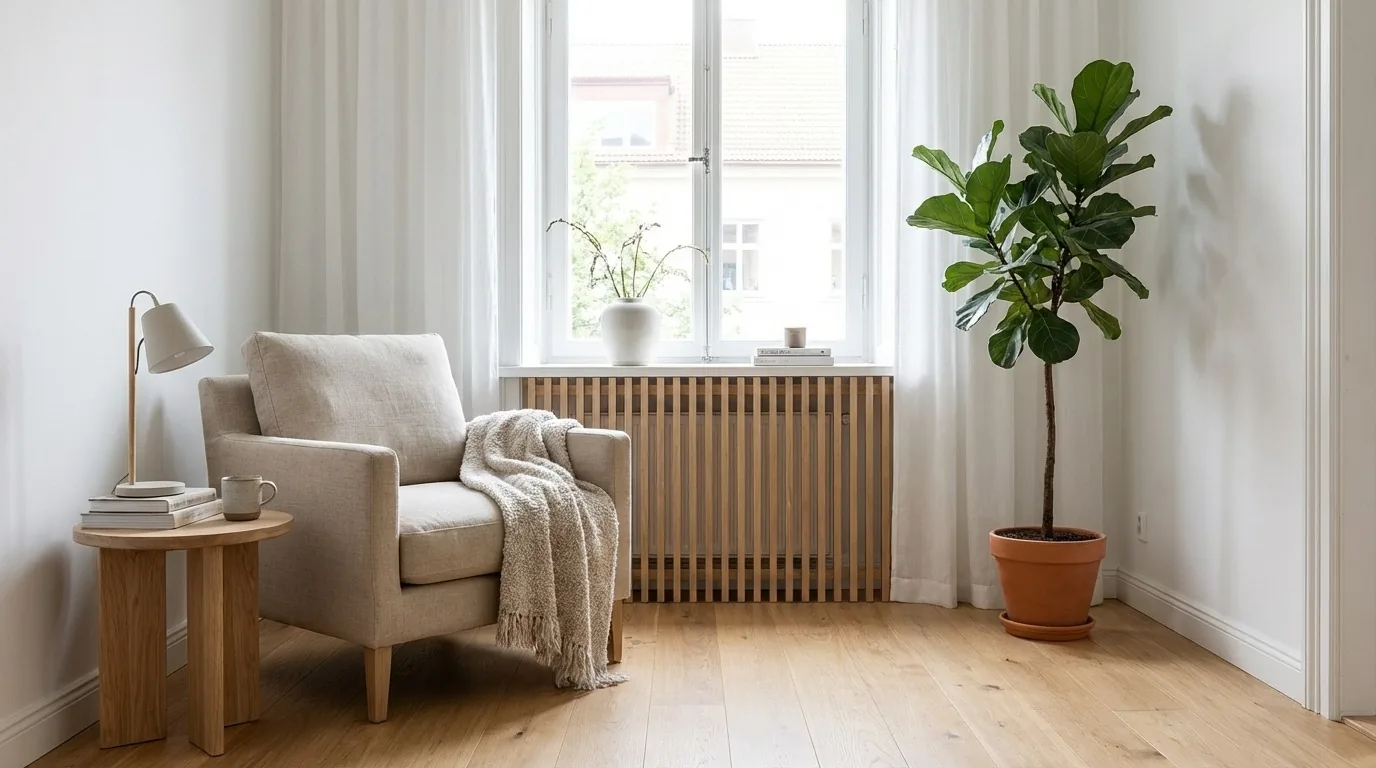
This is where we come in. A bespoke oak cover respects the heritage proportions (often wide, often under windows on exterior walls) and stays modest. Thanks to open slat construction, heat output is preserved.
For heritage homes we recommend:
- Finish: Oiled or smoked — matches floorboards and stucco
- Height: Roughly aligned with existing wainscoting / skirting
- Mount: Free-standing (no drilling into historic plaster)
3. Replace the radiator — nuclear option
Sometimes radiators are simply too big, too leaky, or energetically hopeless. A modern wall radiator (or underfloor heating) is the solution. But: that's a job for a plumber, costing €800–2,500 per radiator.
Typical heritage dimensions — what we often build
| Era | Typical radiator width | Ordered size |
|---|---|---|
| 1900–1930 (Gründerzeit) | 120–160 cm | Vienna (120) or Hamburg (140) |
| 1930–1960 (Bauhaus / postwar) | 80–120 cm | Innsbruck (80) or Munich (100) |
| 1960–1980 | 100–140 cm | Munich (100) or Vienna (120) |
Stucco, skirting, floorboards: what works together
The most common mistake: a cover looks great on its own — but breaks the visual balance of the room.
Rule of thumb: The cover should harmonise with the floor, not the radiator. Light brown floorboards → Natural or Oiled. Dark parquet → Smoked. White screed → White-pigmented.
Common special cases
Valve on the side
Many heritage buildings have valves sticking out the side. We build covers with cutouts — you photograph it, send it to us, done.
Tight gap below windowsill
Also solvable. Below 3 cm clearance, we recommend a flat variant without top panel.
Radiator behind stucco columns or wall cladding
Tricky — but solvable. Send a photo, we quote within 24 hours.
Configure your heritage cover in 2 minutes
Bespoke · Custom shapes · Free EU shipping